
ERPNext Consulting: When Business Growth Changes the Rules
- October 6, 2026
- 10 min read
There is a point in every growing business when the old way of working quietly stops working. It doesn’t happen with a warning. There is no sudden system failure or dramatic announcement. Instead, the sales team starts maintaining another spreadsheet, finance begins reconciling numbers from different sources, inventory records need constant checking, and managers spend more time asking for updates than acting on them. The business is growing, but the systems supporting it are struggling to keep pace. This is where ERPNext Consulting becomes less about choosing software and more about understanding what the business has become.
It Starts With a Problem Nobody Notices at First
In the early stages, separate systems rarely feel like a problem. A spreadsheet here, an accounting application there, an email approval somewhere in between—it all seems manageable when the team is small. But growth changes the equation. More customers mean more transactions. More employees mean more handoffs. More products mean more inventory information. Eventually, the same piece of information starts travelling through several people and systems before it reaches the person who actually needs it.
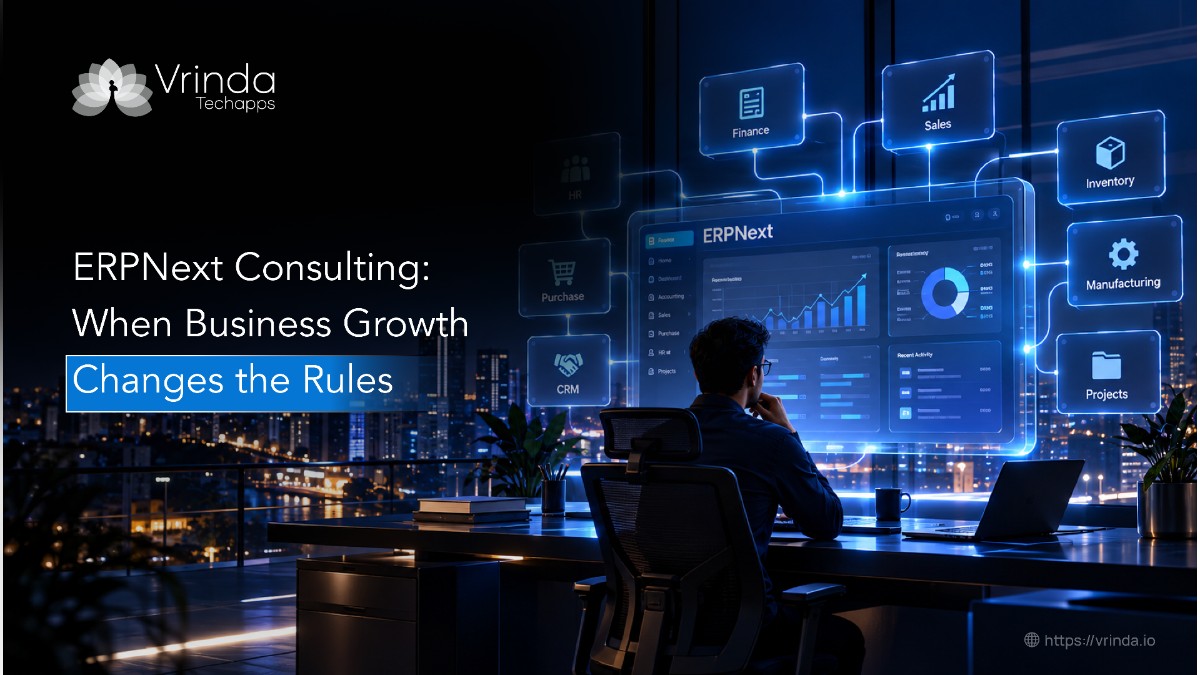
That is usually when businesses start looking at ERPNext. ERPNext brings functions such as finance, sales, purchasing, inventory, human resources, manufacturing, and projects into a connected environment. The real question, however, is not whether ERPNext has these capabilities. It is whether those capabilities can be shaped around the way the business actually operates.
Before the Software Comes the Investigation
This is where a good ERPNext Consultant can make a significant difference. Instead of beginning with a list of modules, the process should begin with questions. How does an order move through the company? Where does information get entered more than once? Which approvals slow people down? How is inventory updated? How does finance receive information from sales? Which reports take too long to prepare?
These questions reveal the gaps that aren’t always visible from the management level. A process that looks simple on paper may involve several people and multiple manual steps behind the scenes. By understanding those details first, the ERP can be planned around actual business requirements instead of forcing employees to change everything simply to fit the software..
The Biggest Mistake Is Trying to Recreate Everything
A capable ERPNext Consultant should know when to challenge that approach. Not every requirement needs custom development. Some can be handled through standard functionality. Others can be solved through configuration or a simpler workflow. There will certainly be situations where customization is the right choice, but it should serve a genuine business need rather than preserve an inefficient process simply because employees are familiar with it.
This is one of the most important parts of ERPNext Consulting: understanding the difference between a requirement the business genuinely needs and a habit the business has simply carried forward.
Your Data Tells Another Part of the Story
There is another challenge that often receives less attention than it deserves: data. Years of customer records, product information, supplier details, transactions, and financial information may exist across different systems. Some records will be duplicated. Some will be outdated. Some may follow completely different naming conventions.
Moving everything into ERPNext without reviewing it first can create a clean-looking system filled with unreliable information. That is why data migration needs to be planned early. The information should be reviewed, cleaned, mapped to the new structure, transferred carefully, and validated before teams begin depending on it.
Then Comes the Hardest Part: Getting People to Use It
Employees have developed their own ways of getting work done. They know which spreadsheet to open, who to message, where to find a particular number, and which workaround saves them ten minutes. When a new system arrives, those habits do not disappear automatically.
That is why implementation needs to involve the people who will actually use the system. Their feedback can reveal problems that aren’t obvious during technical testing. Training should also explain how the new workflow fits into their everyday responsibilities, rather than simply showing them where different buttons are located.
This Is Where Good Consulting Becomes Visible
Effective ERPNext Consulting is not about making the implementation look impressive. It is about making the final system make sense.
The work moves from understanding the business to mapping processes, defining requirements, configuring ERPNext, identifying genuine customization needs, connecting other systems, preparing data, testing real scenarios, and supporting users through the transition. The same thinking applies to the role of an ERPNext Consultant. The value lies not only in knowing how the platform works, but in understanding why a business needs something and finding the most sensible way to achieve it.
When the System Finally Becomes Part of the Business
A manager gets a report without waiting for someone to combine information from several departments. A sales executive can access the information required to speak to a customer. Finance spends less time reconciling data from different sources. Inventory becomes easier to track. Approvals stop disappearing inside email conversations.
These changes may sound simple, but together they change how a business operates. People spend less time finding information and more time using it. That is the point at which ERPNext Consulting stops being a technology project and starts becoming a business improvement exercise.
Where Vrinda Techapps Comes Into the Picture
At Vrinda Techapps, we approach ERPNext with the business behind the software in mind. We don’t begin by assuming that every organisation needs the same modules, workflows, or customizations. We first understand the way the company operates, the challenges its teams face, and the outcomes it expects from the ERP.
Our team can work across implementation, configuration, customization, integrations, data migration, testing, training, and ongoing support. More importantly, we can look beyond the ERP itself. A business may also have a website, mobile application, CRM, payment platform, or other internal systems that need to communicate with it..
The Best ERP Is the One You Stop Thinking About
The right ERPNext Consultant understands that success isn’t measured by how many features have been configured or how much customization has been added. It is measured by whether information moves more clearly, whether employees can work with less friction, whether managers have better visibility, and whether the system can continue adapting as the business changes.
That is the real purpose of ERPNext Consulting. Not simply putting ERPNext into a company, but making it fit the company well enough that people can stop working around their systems and start working with them.
At Vrinda Techapps, that is the difference we aim to create: technology that understands the business, supports the people behind it, and makes everyday operations easier to manage.