
Your business may already rely on websites, mobile apps, payment platforms, CRM tools, marketplaces, or internal applications. ERPNext API Integration connects these systems so information can move where it needs to go without your teams having to enter the same data repeatedly.
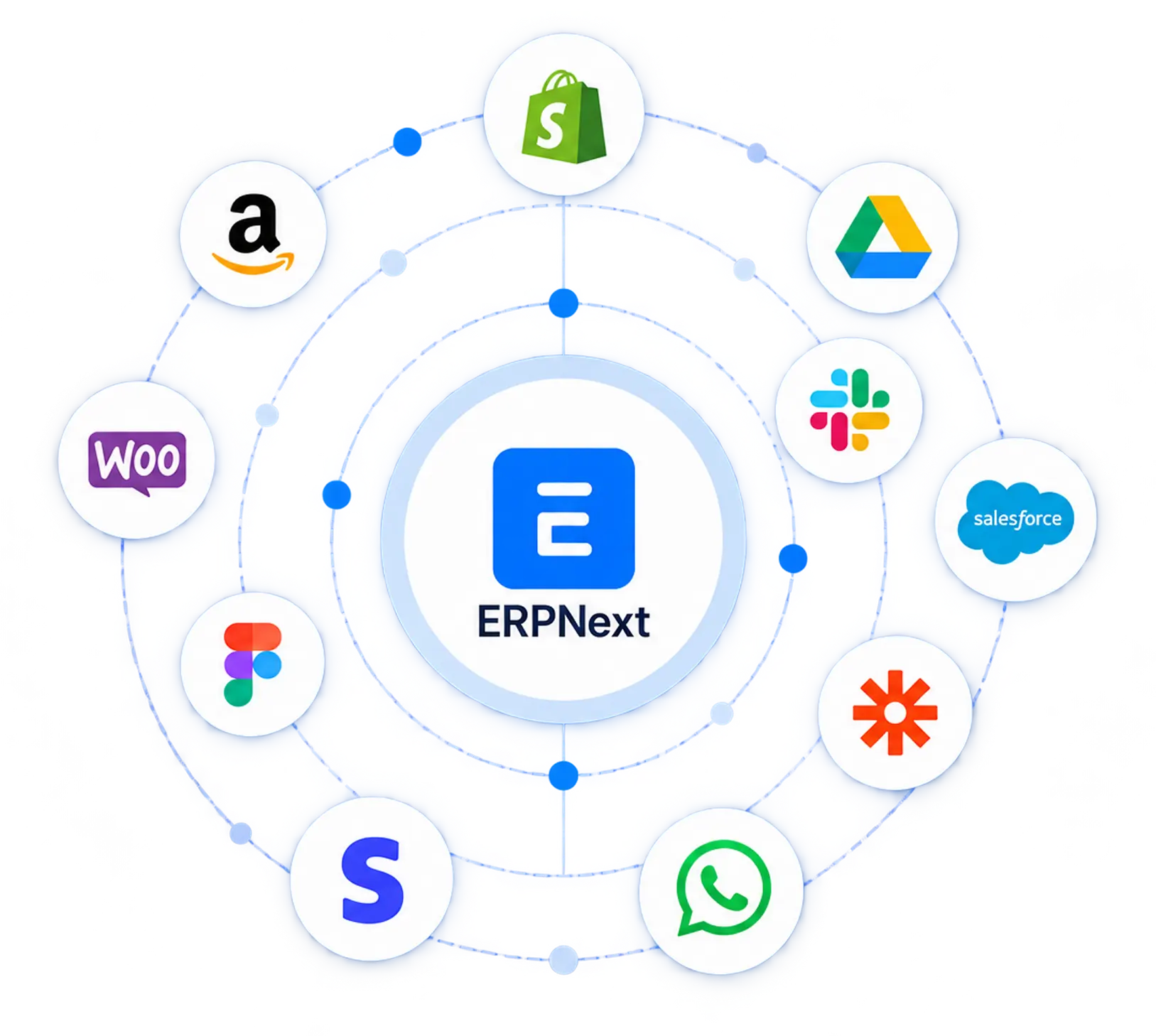
You may already know that your current system isn’t working well enough. You may be dealing with too much manual work, inconsistent information, disconnected applications, or reporting that takes too long.
You don’t necessarily need to know exactly what the solution should look like.
THAT’S WHERE WE COME IN.
Tell us what isn’t working. Tell us where your teams are losing time. Tell us what you want your business system to do better.
As an ERPNext Service Provider, Vrinda Techapps can assess your requirements and help you determine whether ERPNext is the right fit and what the implementation should look like.
A customer places an order through your website. Someone enters it into the ERP manually. A payment is received through another platform. The finance team checks it separately. Inventory gets updated somewhere else.
None of these steps may seem difficult on their own. Together, they create unnecessary work.
This is where ERPNext API Integration becomes useful.
APIs allow systems to share information with one another rather than each application being a silo from the others. Depending on the rules you set for your organization, customer information, orders, payments, inventory data, invoices and other relevant data can transfer between linked platforms. It’s more than just linking two applications. It is to bridge the gaps between them.
The systems you need to integrate depend on how your business operates. Some companies need
one connection between ERPNext and their website. Others may have several applications that need
to exchange information.
Link your website or online store with ERPNext so that orders, customer details, items and inventory information may flow between two systems.
Seamlessly connect your mobile app to ERPNext so that vital business, customer and order information may flow between your app and your ERP without repetitive laborious work.
Connect your payment system with ERPNext to keep payment information and transaction history in sync for easy management of financial information.
Synchronize customer and sales data across your CRM and ERPNext so your team has the information they need.
If you are selling across various marketplaces, link them to ERPNext so that orders and important customer information are brought together in one location instead of processing everything manually.
ERPNext can also be connected with custom applications developed specifically for your organisation. We assess the existing technology before deciding how the systems should communicate.
There is no universal integration setup. A business selling products online may need orders to move from its website into ERPNext, while inventory updates need to travel in the opposite direction. A service company may need customer information and invoices to move between an internal application and ERPNext.
Converts custom JSON schemas to standard Frappe/ERPNext DocTypes with validation rules.
API Key/Secret, OAuth 2.0, and role-based access scoped specifically per resource.
Guaranteed delivery using asynchronous message workers ensuring no record is ever dropped.
Background pipelines that ensure employees never leave their native tools.
At Vrinda Techapps, we first understand what information needs to move, where it starts, where it needs to go, and what should happen once it arrives. This gives us a clearer picture of the integration instead of simply connecting systems because an API is available.
Therefore, our ERPNext API Integration work is customized to your real process. We analyze the applications involved, the type of data shared, the frequency of communication and the activities that need to happen automatically.
A good ERP plan should be understandable to the people making business decisions, not just the technical team. As an ERP consultant, Vrinda Techapps is able to examine the connection of your current systems with ERPNext before you begin with the deployment. These might be websites, CRM systems, accounting software, payment systems, bespoke software or other company tools.
Information submitted in one system may be transferred to another, so staff don’t have to enter the same facts numerous times.
The more integrated systems that automatically share information, the less teams depend on records that are updated manually.
Information that is relevant can flow across apps without waiting for someone to move it by hand.
Automation of routine system-to-system tasks frees up the worker to spend more time on work that requires his attention.
As your IT landscape evolves, a well-architected integration may take in more apps and processes.
Partner with Vrinda Techapps for premium enterprise engineering that scales with your global ambition.

We assess your current systems and clarify your integration goals. We identify the data flow requirements and outline the necessary business processes to ensure seamless connectivity between your applications.
We begin by examining the systems you already have in place and understanding what you want them to do together. Then we define the information that needs to flow between them and map the required business processes.
And before the integration is part of your normal operations, there’s testing. We test if the information is sent successfully, if the connected systems respond as expected and how the configuration performs in different circumstances.
Once we have the requirements we start working on the technical connection (API endpoints, authentication, data structures, how to handle requests, rules for how the information should be handled, etc).
Then the integration is readied for deployment with the relevant documentation and technical concerns. This strategy makes sure the project stays focused on the business process, and not on integration as a technical exercise.
Not all information should move between systems in the same way.Some data may need to be transferred immediately. Other information may
only need to move at specific intervals. Some fields may need to be transformed before they may be used in other applications.
Immediate trigger-based updates for incoming orders, payments, and emergency stock reservation to avoid overselling.
Ideal for end-of-day accounting entries, general ledger adjustments, and bulk product catalog updates.
On-the-fly conversion of units of measure, tax classifications, and local currencies before writing to ERPNext.
Such aspects are evaluated at the integration planning stage.
ERPNext API Integration, we analyze the data structure at the source and target ends and determine how the data should be mapped. This might contain customer lists, product descriptions, order details, payment information, inventory levels, invoices or other business-specific data.
The goal is to ensure that the linked systems know what they’re exchanging and that the integration supports the process it was built for.
You don’t need to replace your present software to leverage ERPNext better.
If your organization already has a CRM, website, mobile application, accounting tool, marketplace link or unique internal platform, we can check if it can be integrated with ERPNext.
If you are building a bespoke application, you may construct the integration to fit within your application’s existing architecture and the information your business needs to share.
Vrinda Techapps is an ERPNext API integration service provider working with mainstream applications and custom-designed systems. We don’t try to sell you on a certain technological stack, but instead we look at the specific connection your organization requires.
Engineering consultations available
An integration should be seamless to your present operations and should not introduce
a new layer of complexity to the way your staff manages.
This involves knowing what occurs prior to the data being transmitted, throughout its transmission and what the system that receives it needs to do with it.
We keep these practicalities in mind during the project at Vrinda Techapps. Our team works with your business requirements to create an integration that supports the processes your people already understand.
With ERPNext API Integration, the aim is not to make your systems look more connected. It is to make your business work more connected.

You don’t need to have your whole ERP plan mapped out before you talk to us.
Tell us how your firm operates currently, what doesn’t function so well and what you want your future system to do.
As an ERPNext consultant, Vrinda Techapps can help you translate those needs into a clear course of direction for your ERP project.
Let’s talk about your company needs and what ERPNext can do for you.
Vrinda Techapps
Architecture / Experience / Payload CMS development
An integration should be seamless to your present operations and should not introduce
a new layer of complexity to the way your staff manages.
Whether you need to connect an e-commerce platform, payment gateway, CRM, mobile application, marketplace, or a custom business system, Vrinda Techapps can help you plan and implement the right integration.
ERPNext REST & Webhooks
Our ERPNext API Integration services are designed around your systems, your data, and your workflow.
Tell us what you are trying to connect, and let's work out the right way to make those systems work together.
