
Keep finance, sales, inventory, purchasing, and people connected without making your team manage a pile of separate tools. Vrinda Techapps helps growing businesses choose, configure, and use ERP solutions that fit the way they actually work.
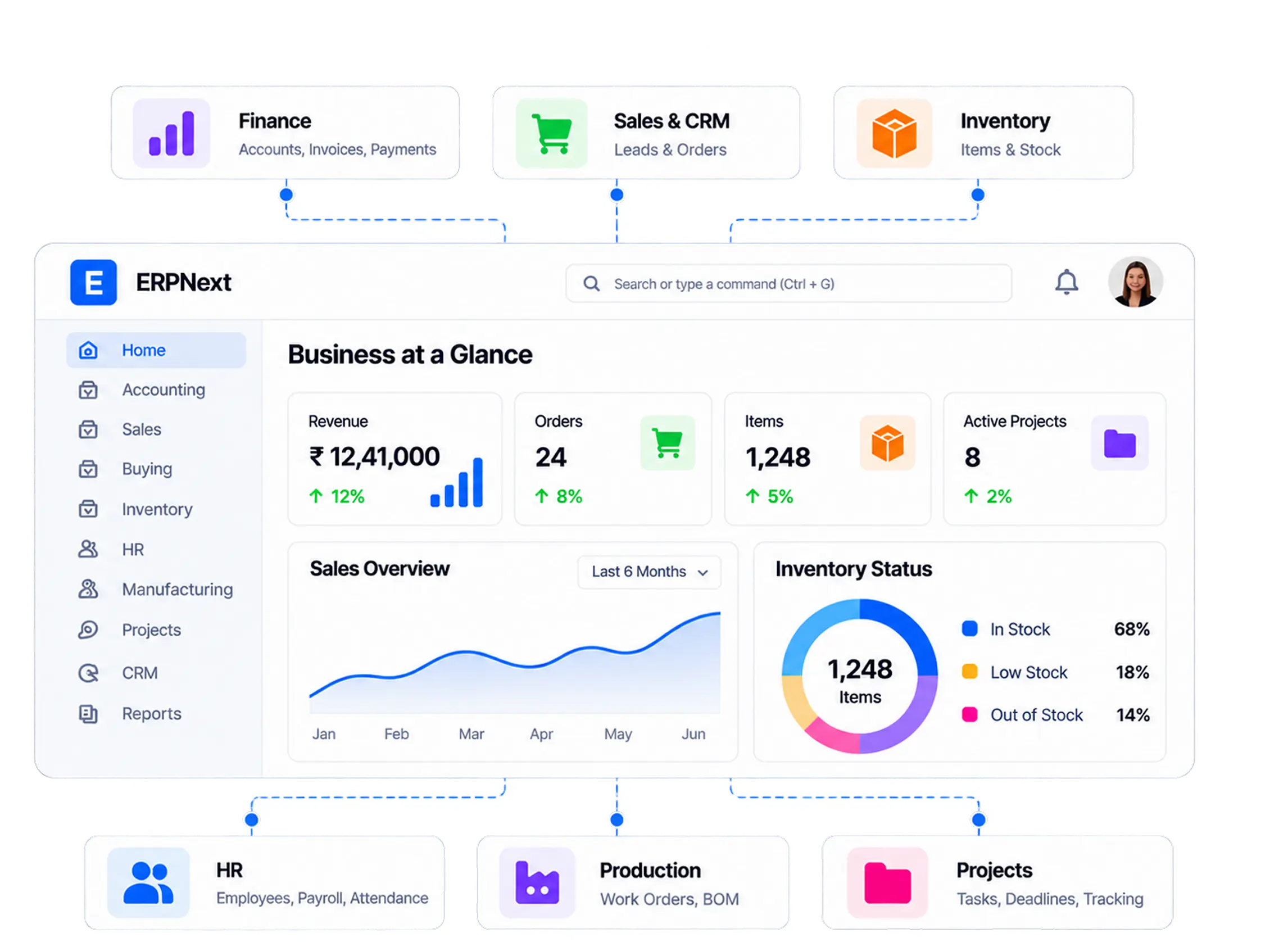
ERP software can look impressive on a product page. What matters when you actually start using it is whether it fits your business.
A retail company may care most about stock and orders.
A service company may need projects, billing, and customer information in one place.
A growing manufacturer may need purchasing, production, inventory, and finance to work together.
That is why choosing a cloud based ERP for small business should begin with your processes, not a list of features.
At Vrinda Techapps, we look at how your business operates today. What takes too long? Where is information entered twice? Which reports are difficult to prepare? Which teams depend on another team?
Those answers give us a better starting point than simply selecting modules.
A small business can run comfortably with spreadsheets, standalone apps, and a few manual processes. Then the orders increase. More people join the team. Inventory gets harder to track. Finance needs cleaner records. Suddenly, information is sitting in too many places.
That is where ERP starts making sense.
A cloud ERP for small business does not have to mean a huge software project or a system packed with features nobody uses. A cloud ERP for small business brings the important parts of the business together and gives your team one place to work from.
The idea is simple: spend less time moving information around and more time using it. That is where a cloud ERP for small business can make everyday work easier.
The value of ERP is often found in the everyday details.
Bring invoices, expenses, payments, accounts, and financial information into one organised environment. Your finance team can spend less time collecting information from different sources.
Keep leads, quotations, customer records, orders, and follow-ups connected. Sales teams can work with current information instead of relying on scattered files.
Know what is available, what has moved, and what needs to be ordered. A cloud based ERP for small business can give your team a clearer picture of stock without constant manual checking.
Keep supplier details, purchase orders, and related records together. This makes it easier to follow what has been ordered and what still needs attention.
Employee records, attendance, leave, and other HR activities can be managed through the same environment, giving your team one place for routine information.
For businesses working on projects, tasks, timelines, billing, and responsibilities can be brought together so teams have a clearer view of ongoing work.
Partner with Vrinda Techapps for premium enterprise engineering that scales with your global ambition.

For a growing business, software infrastructure can be another thing to worry about. A cloud based ERP system for small business removes much of that overhead by keeping the system accessible without requiring the business to manage its own ERP infrastructure.
Your team can access the system from supported locations and devices, while updates and maintenance can be handled within the cloud environment.
There is also a practical advantage when teams are no longer working from one office. Finance may be checking records from one location while sales are following up with customers somewhere else. A cloud based ERP system for small business gives both teams access to the same business information.
API Key/Secret, OAuth 2.0, and role-based access scoped specifically per resource.
Continuous security updates and feature rollouts without costly server maintenance.
Daily automated multi-region backup integrity with point-in-time recovery.
This makes the project manageable and provides staff time to adapt.
You may not need every module on day one. You may only need finance, sales, and inventory initially. Additional features can be built as the business expands.
Start with the areas that provide the greatest friction, get your team acquainted with the system and grow when you have real business need.
Technology is just one aspect of an ERP implementation. Another aspect is getting people and procedures aligned with it.
We’ll take a look at how information flows through your firm currently and then offer a configuration. That is how we determine what to keep, what can be enhanced and what can be automated.
And not everything has to be turned on. We choose the functionalities that make sense for your organization and keep the system simple for staff to grasp.
You may need to clean, organize and map existing spreadsheets and records before they can transfer into the new system. Instead we include this as a consideration, rather than have migration as an afterthought.
Small company owners need a cloud ERP that works in real business scenarios. We test the processes, permissions, transactions and reports before putting the system into live operation.
Those questions usually arise after employees start utilizing the system on a daily basis. We provide support and make adjustments where the business requires them.
In a disconnected setup, someone may receive the order, another person may update the inventory, finance may record the payment separately, and the customer information may sit in another application.
With a cloud based ERP system for small business, those activities can be connected through one system and the workflows defined for your organisation.
The benefit is not that software does everything. Your team simply repeats less work.
That distinction matters. Good ERP should make work clearer, not make the software itself another task.
Auto-captured from customer interaction channel
Real-time depletion across all warehouse locations
Invoices generated and synced with reconciled bank feed
Complete order history attached to customer profile
Small businesses do not stay the same size forever. New customers arrive, teams expand, product ranges change, and processes become more involved.
A cloud ERP for small business can give you a central system that develops with those changes. You can introduce additional users, workflows, modules, and integrations when your operations call for them.
Plan for growth without paying for complexity you do not need today.
At Vrinda Techapps, we look at both sides of that equation. We look at what your company requires now and where your operations could go, and then we customize the ERP solution for those needs.


Tell us where your current processes are getting in the way. We will look at your requirements, understand the gaps, and help you decide what the right ERP approach looks like for your business.
Tell us what you’re trying to improve. Let’s find the right ERPNext approach for your business.
Vrinda Techapps
Architecture / Experience / Payload CMS development
ERP implementation should not feel like handing your business over to a software platform and hoping everything falls into place.
We take a practical approach. We listen to the people using the system, understand the processes behind the requirement, and then shape the technology around them.
Our team covers planning, configuration, customization, integration, migration, testing, deployment, and support. This gives your project continuity.
We keep communication straightforward, so you know what is changing and how it affects your team.
Planning
Configuration
Customization
Integration
Migration
Testing
Deployment
Support
If your business has outgrown spreadsheets and disconnected applications, an ERP may be the next practical step. A cloud based ERP system for small business does not need to make your business more complicated. It should make the way you already work easier to manage.
Vrinda Techapps can help you assess your requirements, identify the right approach, and set up a system that can support your business today while leaving room for tomorrow.
